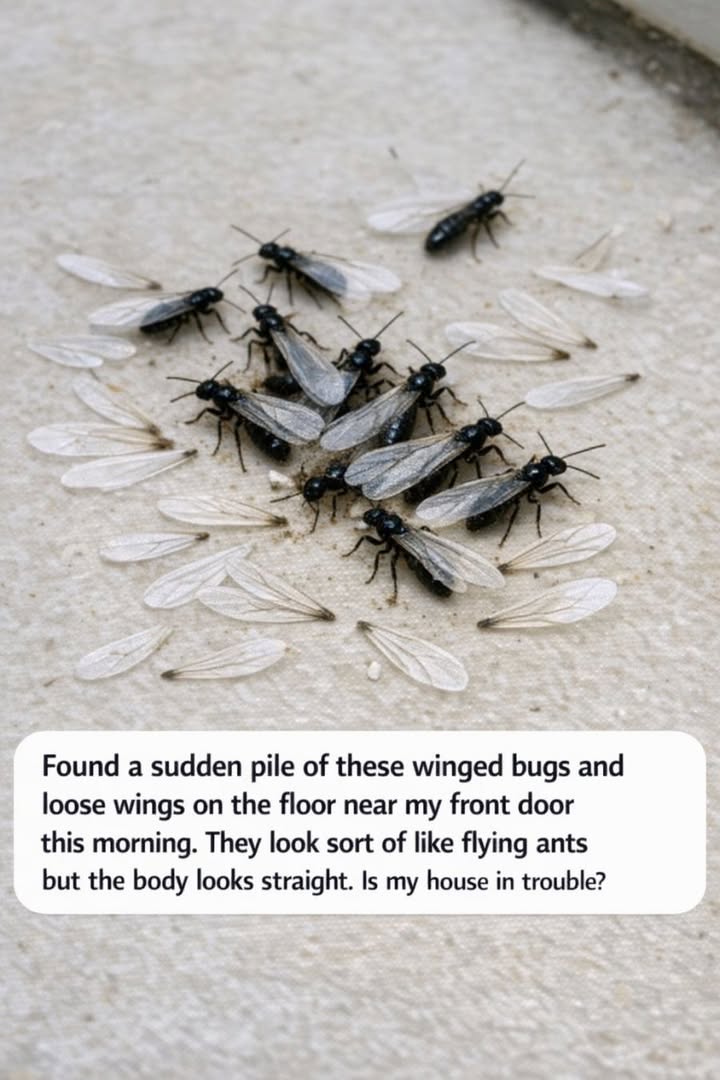
Finding a sudden pile of winged insects or loose wings near your front door can be an alarming discovery. These winged bugs are most likely swarmers, the reproductive members of a termite colony, which appear during specific times of the year to mate and establish new colonies. Unlike worker termites, which remain hidden as they consume wood, swarmers are a visible sign that termites are nearby.
Understanding the difference between flying ants and termite swarmers is crucial for homeowners. Termites can cause significant damage to your property if not addressed promptly. This article aims to help you identify these insects correctly, understand their behavior, and take appropriate action to protect your home.
1. Are Those Really Flying Ants Or Termite Swarmers?
Identifying whether the insects you found are flying ants or termite swarmers is the first step. Termite swarmers, also known as alates, have straight antennae, a uniformly thick waist, and two pairs of wings of equal length. In contrast, flying ants have bent antennae, a narrow, pinched waist, and forewings that are longer than their hind wings.
Measurements can also be a helpful factor in identification. Termite swarmers typically measure about 1/4 to 3/8 inch in length, including their wings. Observing these characteristics can help you determine whether you are dealing with termites, which require immediate attention, or flying ants, which are less damaging.
2. How To Identify Subterranean Termite Swarmers And Their Shed Wings
Subterranean termite swarmers are generally dark brown or black and often confused with flying ants due to their similar appearance. They emerge from their colonies in large numbers, especially after rain, seeking to mate and establish new colonies.
Their wings are a critical identification feature. Termite wings are translucent with a distinct vein pattern and typically measure about 3/8 inch. The wings are easily shed after mating, which is why you might find piles of wings near entry points like doors and windows. These shed wings are an indicator that termites are or have been present.
3. Why Termites Suddenly Swarm Around Doors, Windows, And Lights
Termites swarm as a natural part of their reproductive cycle. They are attracted to light and often gather around windows, doors, and light fixtures, making these areas prime locations to find swarms and shed wings.
Swarming is most common during warmer months and typically occurs during the day. The presence of swarmers near entry points like doors and windows suggests that there might be an established termite colony nearby, possibly within your home or in the surrounding area.
4. What A Pile Of Wings On The Floor Actually Means For Your House
A pile of wings on the floor is a sign that termites have swarmed in your home. While the presence of swarmers does not necessarily mean there is a structural infestation, it does indicate that a colony is nearby, either inside or very close to your home.
This discovery is a call to action for homeowners. It’s crucial to investigate further to determine if termites have already begun causing damage within the structure of your home. Ignoring the presence of termite swarmers could lead to significant and costly damage.
5. Signs Your Home May Already Have A Hidden Termite Infestation
In addition to finding swarmers or their wings, other signs of a termite infestation include mud tubes on exterior walls, wooden structures that sound hollow when tapped, and damaged wood that is soft and easily punctured.
Frass, or termite droppings, near wooden structures is another indicator of an infestation. If you notice any of these signs, it’s likely that termites have been active in your home for some time and immediate action is required to prevent further damage.
Next Page
Pages: 1 2
